Most emails fail in the last line. Not because they are badly written or the idea is weak, but because the ending gives the reader nothing clear to do next.
People do not sit and analyse your message. They scan it, reach the bottom, and make a quick decision. And that decision is shaped almost entirely by how you end the email.
A good ending removes friction and makes the next step obvious and easy. A weak ending sounds polite, but leaves the reader thinking, which usually leads to no response at all.
Key Takeaways
- Most emails fail at the ending. A weak last line creates friction and leads to no response.
- Clarity drives replies. The easier it is to understand what to do next, the more likely someone will respond.
- Avoid vague phrases. “Let me know your thoughts” forces the reader to think and decide.
- Use response-driven language. Ask simple, specific questions that are easy to answer.
- Not every email needs a reply. If no action is required, say it clearly to remove uncertainty.
- Match tone to context. Professional, casual, or formal endings should reflect the relationship and situation.
- A strong ending has three parts. Closing sentence, sign-off, and signature.
- The best test is simple. Read your last line and ask: would I know what to do next?
Why Your Email Ending Matters More Than You Think
Your email ending shapes the recipient’s next action by signalling whether you expect a response, what kind of response you want, and how easy it is to give it.
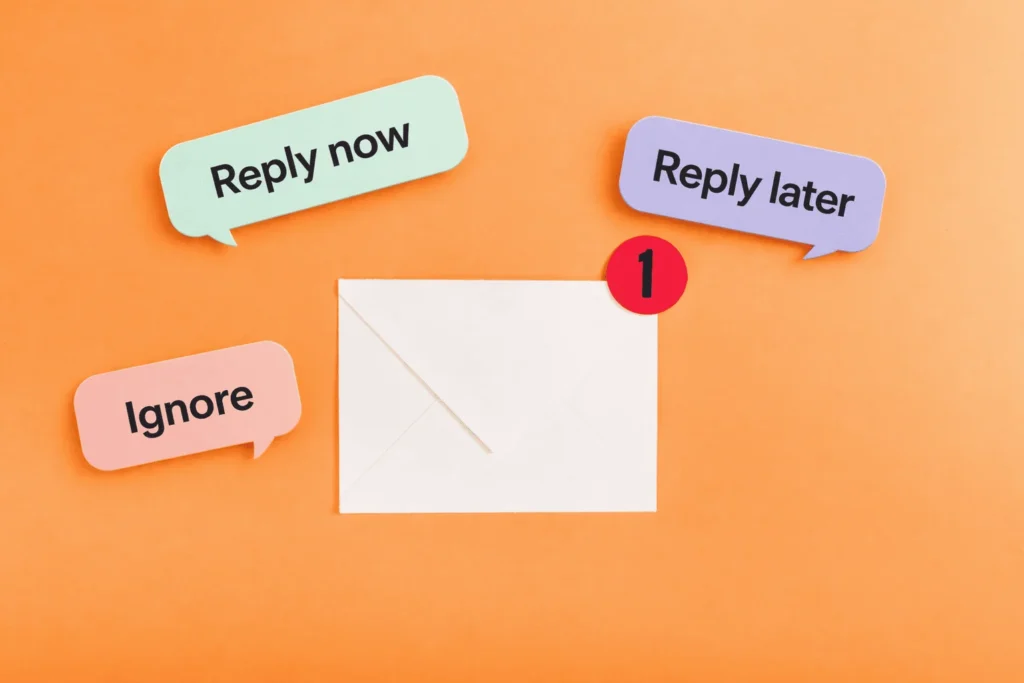
When people reach the end of your email, they make a quick decision:
- Reply now.
- Reply later.
- Ignore.
Your ending is where that decision happens. If it is vague, nothing happens. If it is clear and low-friction, replies increase.
So what does a strong ending actually look like in practice?
The 3-Part Formula: How to End Any Email Professionally
A strong email ending consists of three elements: a clear closing sentence, an appropriate sign-off, and a professional signature that reinforces credibility.
1. The Closing Sentence (Your Response Trigger)
The closing sentence should guide the reader toward a specific next step, ideally one that is easy to act on.
Weak endings:
- Let me know your thoughts
- Looking forward to hearing from you
These sound polite, but they create work for the reader. They have to decide what to do.
Stronger endings:
- Would it make sense to review this together next week?
- Could you confirm if this works on your side?
- Happy to send more details if helpful
The goal here is to reduce thinking.
2. The Sign-Off (Tone Calibration)
The sign-off sets the tone of your message and subtly signals the relationship between you and the recipient.
Sign-Off | Tone | When to Use |
Kind regards | Neutral professional | Default option |
Best regards | Slightly warmer | Ongoing communication |
Thanks | Direct and efficient | When asking for action |
Cheers | Casual | Informal or internal emails |
Sincerely | Formal | Official or legal emails |
Your mistake is rarely choosing the wrong sign-off. It is mismatching tone with context.
3. The Signature (Your Credibility Layer)
Your signature reinforces who you are and why your email matters.
A strong signature includes:
- Name
- Role
- Company
- Optional contact details
Example:
John Smith
Head of Partnerships
ABC Ltd
+44 7XXX XXXXXX
You do not need to overcomplicate it. But removing it entirely often reduces trust, especially in B2B communication.
How to Choose the Right Email Ending (Decision Guide)
The right email ending depends on three factors: relationship, purpose, and urgency.
Ask yourself:
- Do I know this person well?
- Do I need a response?
- Is this formal or conversational?
Quick guide:
Situation | Ending Style |
First contact | Professional and clear |
Ongoing conversation | Slightly warmer |
Internal email | Direct and casual |
High-stakes message | Formal and precise |
When in doubt, optimise for clarity, not creativity.
How to End an Email That Requires a Response
To get a reply, your email ending must reduce friction and make the next step obvious.
Avoid open-ended phrases. Use response-driven language:
- Does this work for you?
- Would you be open to a quick call?
- Can you confirm by Friday?
Each of these works because it narrows the response into something simple and easy to answer.
The less thinking required, the higher the chance of a reply.
When You Don’t Need a Response
Not every email should end with a question. If no action is required, make that clear. Otherwise, the reader may feel unsure whether they need to reply.
Examples:
- No action needed on your side for now
- Sharing this for visibility
- Just keeping you updated
Clarity works both ways – when you want a reply and when you don’t.

How to End an Email: Scenario-Based Endings
Different situations require different levels of clarity, pressure, and tone.
How to End an Email Asking for Information
Be specific about what you need.
Examples:
- Could you share the latest figures when you have a moment?
- Would you be able to send over the updated version of the document?
- Can you confirm the final numbers so I can move this forward?
How to End an Email Awaiting a Response
Add a gentle time anchor.
Examples:
- Just checking if you had a chance to review this earlier note.
- Wanted to follow up in case this got buried on your side.
- Let me know if you need anything else from me to move this forward.
How to End a Follow-Up Email (No Reply)
Keep it light and easy to ignore or respond.
Examples:
- Happy to close this out if it is no longer relevant.
- Let me know if this is something we should revisit later.
- No worries if now is not the right time, just thought I would check in.
How to End an Apology Email to a Client
Focus on resolution.
Examples:
- Please let me know if there is anything further I can do to resolve this.
- I will make sure this is handled properly going forward.
- If anything else comes up, I am here to help.
How to End an Official Email
Keep it structured and formal.
Examples:
- Please confirm receipt of this email at your earliest convenience.
- Kindly review and confirm once approved.
- Let me know if any additional documentation is required.
How to End an Email to a Company (Cold Outreach / B2B)
Make the ask small and relevant.
Examples:
- Would it make sense to explore this briefly next week?
- Is this something currently on your roadmap?
- Open to a quick 10-minute call to see if this is relevant?
Email Ending Templates You Can Copy
Use these as starting points – always adapt them to your specific context.
Templates for Sales and Outreach (B2B Focus)
- Would it make sense to explore this in a quick call next week?
- Open to a short conversation to see if this is relevant for you?
- Happy to share a few ideas tailored to your setup if useful.
- Would you be the right person to speak to about this?
- Shall I send over a quick breakdown with examples?
Templates for Client Communication
- Let me know if you would like me to adjust anything here.
- Happy to make changes based on your feedback.
- Does this align with what you had in mind?
- Let me know if you would like me to refine this further.
- I can update this quickly once I have your input.
Templates for Internal Emails
- Happy to discuss if needed.
- Let me know your thoughts when you get a chance.
- We can review this together if helpful.
- Let me know if anything needs to be adjusted.
- I can take this further once you confirm.
Templates for Formal Situations
- Please confirm once received.
- Kindly review and provide your feedback.
- Awaiting your confirmation to proceed.
- Please advise on the next steps.
- Let me know if further clarification is required.
How to End an Email With Clarity and Confidence
Most email endings fail because they try to sound polite instead of being useful.
Before sending your next email, read the last line only.
Ask yourself: If I received this, would I know what to do next?
If the answer is no, rewrite it.
In practice, improving how you end an email comes down to three habits:
- Replace vague phrases with specific questions or actions.
- Reduce the number of decisions the reader has to make.
- Match your tone to the context instead of defaulting to generic politeness.
You do not need a better email – you usually just need a better last sentence.