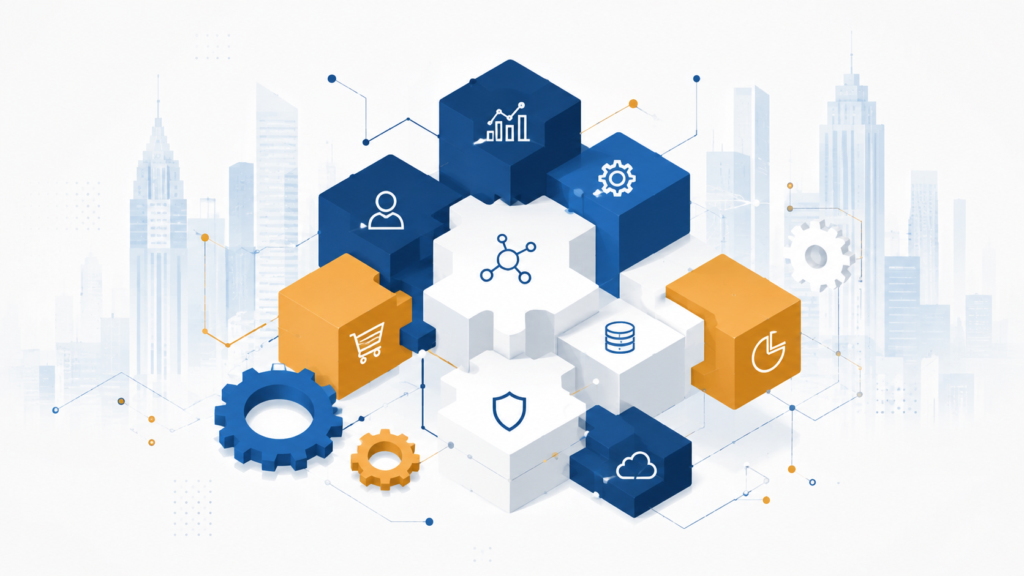
SAP isn’t one product — it’s a family of enterprise systems covering finance, supply chain, CRM, analytics and more, and which ones a company runs says a lot about how it operates. This article breaks down the different SAP products and modules in plain terms, covers the ECC-to-S/4HANA migration story that’s forcing decisions across the SAP install base right now, and shares a breakdown of our own SAP Users List, which currently covers 40,512 companies and 174,201 decision-maker contacts worldwide.
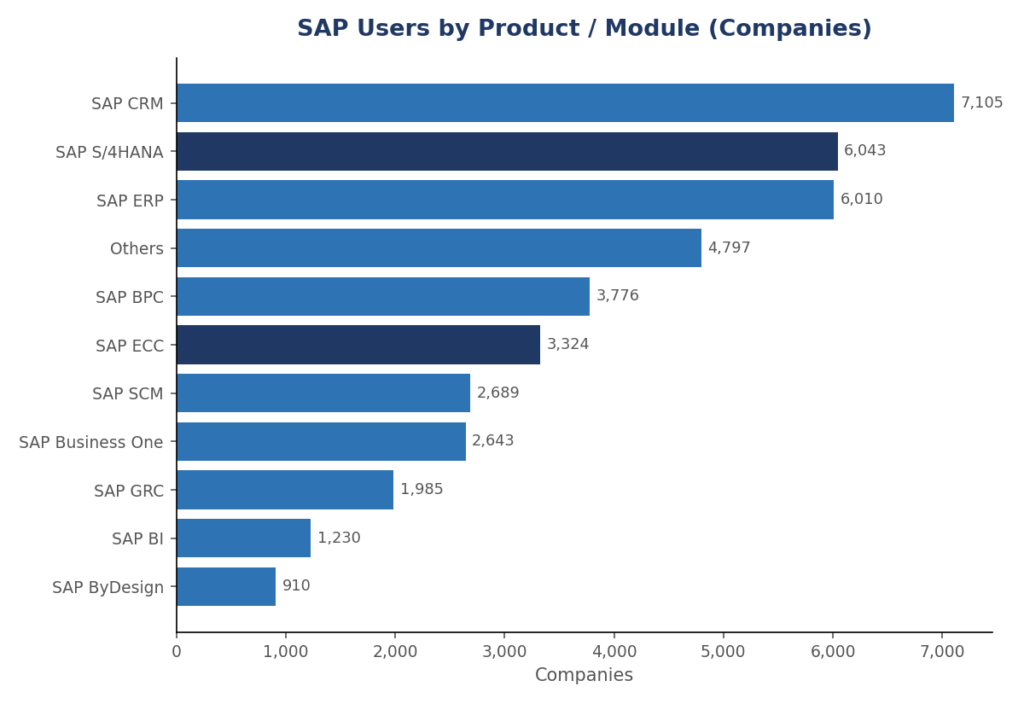 SAP is best understood as a family of products built around a common core, each aimed at a different part of the business. Here’s what each one covers, and how many companies in our database use it:
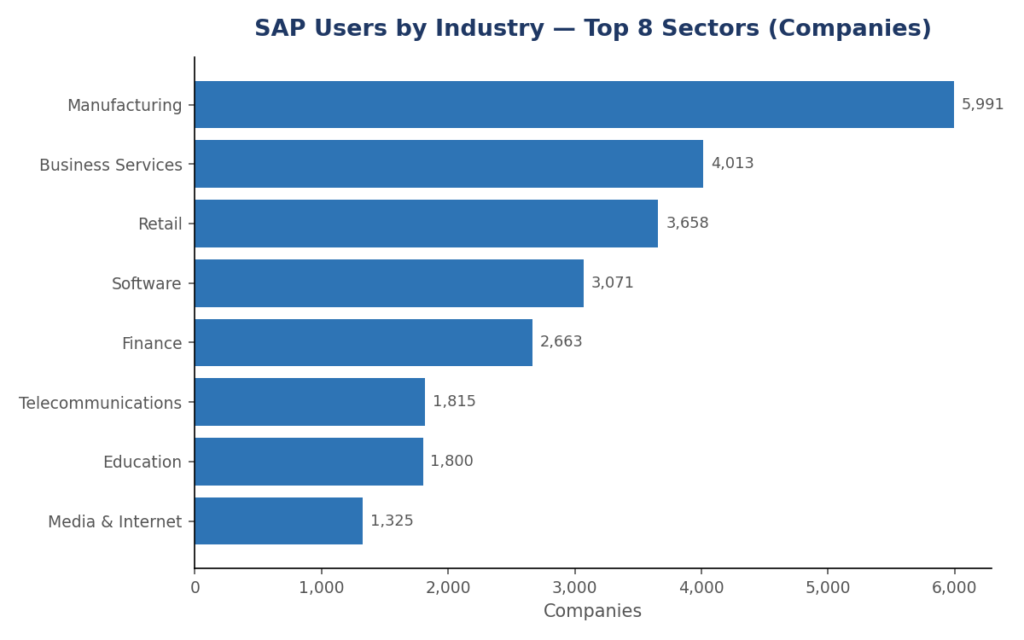 Manufacturing is the single largest industry in our SAP database (5,991 companies, 14.8% of the total) — unsurprising, given SAP’s roots in manufacturing and supply-chain ERP. Business Services (4,013, 9.9%) and Retail (3,658, 9.0%) follow behind.
That’s a heavier manufacturing concentration than we see in our Salesforce data, where Business Services and Retail lead — a reflection of SAP’s core strength in production planning, inventory and supply-chain modules that CRM-first platforms simply don’t cover. See the full breakdown, covering all 24 sectors, on our SAP Users List page.
Manufacturing is the single largest industry in our SAP database (5,991 companies, 14.8% of the total) — unsurprising, given SAP’s roots in manufacturing and supply-chain ERP. Business Services (4,013, 9.9%) and Retail (3,658, 9.0%) follow behind.
That’s a heavier manufacturing concentration than we see in our Salesforce data, where Business Services and Retail lead — a reflection of SAP’s core strength in production planning, inventory and supply-chain modules that CRM-first platforms simply don’t cover. See the full breakdown, covering all 24 sectors, on our SAP Users List page.
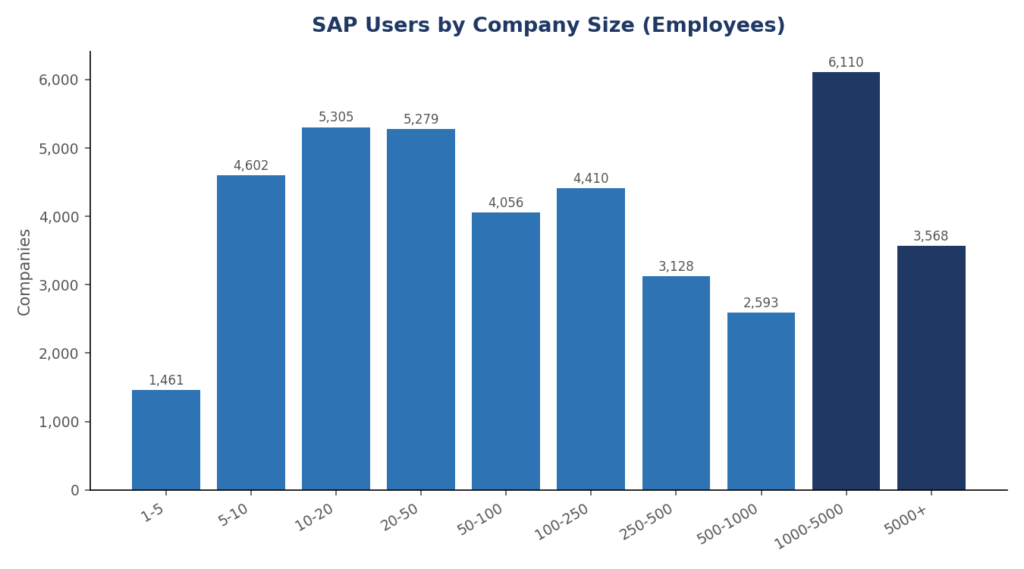 62.0% of the companies in our database (25,113) have fewer than 250 employees, while 38.0% (15,399) are larger enterprises with 250+ employees. That’s a notably higher enterprise concentration than we see on Salesforce (26.0%) or HubSpot — consistent with SAP’s reputation as the ERP of choice for larger, more complex organisations.
Even so, well over half the database is under 250 employees — SAP Business One and ByDesign exist specifically to serve that smaller end of the market, so a strategy built only around enterprise accounts would miss a majority of the addressable audience.
62.0% of the companies in our database (25,113) have fewer than 250 employees, while 38.0% (15,399) are larger enterprises with 250+ employees. That’s a notably higher enterprise concentration than we see on Salesforce (26.0%) or HubSpot — consistent with SAP’s reputation as the ERP of choice for larger, more complex organisations.
Even so, well over half the database is under 250 employees — SAP Business One and ByDesign exist specifically to serve that smaller end of the market, so a strategy built only around enterprise accounts would miss a majority of the addressable audience.
How Many Companies Use SAP, and Where?
SAP is used by hundreds of thousands of organisations globally, from multinational manufacturers to mid-sized regional firms. Our own database — built and independently verified — currently covers 40,512 companies and 174,201 individual contacts.- USA: 28,631 companies (70.7% of the total) — by far the largest single market.
- UK: 4,723 companies (11.7%), 20,310 contacts — a clear second.
- Canada: 1,354 companies (3.3%) — third, ahead of Australia and India.
SAP Products and Modules Explained
SAP is best understood as a family of products built around a common core, each aimed at a different part of the business. Here’s what each one covers, and how many companies in our database use it:
- SAP ECC (ERP Central Component): SAP’s long-standing core ERP suite (3,324 companies) — the platform most large enterprises have run for the last two decades, now approaching its mainstream support deadline (see next section).
- SAP S/4HANA: SAP’s next-generation ERP suite (6,043 companies), built exclusively on the in-memory HANA database for real-time processing and a modern interface — the successor most ECC customers are migrating toward.
- SAP ERP: used here as the broader ERP-suite category (6,010 companies) covering finance, procurement and operations, distinct from customers already tagged specifically as ECC or S/4HANA.
- SAP CRM: sales, marketing and customer-service functionality (7,105 companies) — the largest single category in our data, reflecting how many SAP customers run CRM alongside their core ERP.
- SAP BPC (Business Planning and Consolidation): budgeting, forecasting and financial consolidation (3,776 companies) — used mainly by finance teams at larger, multi-entity organisations.
- SAP Business One: a separate, lighter-weight ERP built specifically for small and mid-sized businesses (2,643 companies), not a cut-down version of the enterprise suite.
- SAP SCM (Supply Chain Management): planning, logistics and supply-chain execution (2,689 companies) — concentrated among manufacturing, retail and distribution companies.
- SAP GRC (Governance, Risk and Compliance): audit, risk and regulatory-compliance tooling (1,985 companies), most common in finance, insurance and heavily regulated industries.
- SAP Business Intelligence (BI): reporting and analytics (1,230 companies), often layered on top of one of the ERP products above rather than run standalone.
- SAP ByDesign: SAP’s cloud ERP for mid-market companies that want a fully managed, cloud-native alternative to Business One or S/4HANA (910 companies).
SAP ECC vs S/4HANA: Why This Split Matters Right Now
Globally, S/4HANA already has nearly double the company count of ECC in our data — 6,043 vs. 3,324 — and that gap is set to widen. SAP’s mainstream maintenance for SAP Business Suite 7, which includes ECC, ends on 31 December 2027, with an optional extended-maintenance period available through 2030 at an additional cost. SAP has confirmed there will be no further extension to that date. Companies still running ECC are actively evaluating their options: migrate to S/4HANA (on-premise or cloud), move to extended maintenance, or switch platforms entirely. That makes ECC-tagged companies an unusually responsive audience right now for migration services, system integration, and consulting — the deadline is doing the work of creating urgency that a cold pitch normally has to manufacture. Source: SAP — Maintenance Strategy for SAP Business Suite 7 and S/4HANA (official)SAP Users by Industry
Manufacturing is the single largest industry in our SAP database (5,991 companies, 14.8% of the total) — unsurprising, given SAP’s roots in manufacturing and supply-chain ERP. Business Services (4,013, 9.9%) and Retail (3,658, 9.0%) follow behind.
That’s a heavier manufacturing concentration than we see in our Salesforce data, where Business Services and Retail lead — a reflection of SAP’s core strength in production planning, inventory and supply-chain modules that CRM-first platforms simply don’t cover. See the full breakdown, covering all 24 sectors, on our SAP Users List page.
SAP Users by Company Size
62.0% of the companies in our database (25,113) have fewer than 250 employees, while 38.0% (15,399) are larger enterprises with 250+ employees. That’s a notably higher enterprise concentration than we see on Salesforce (26.0%) or HubSpot — consistent with SAP’s reputation as the ERP of choice for larger, more complex organisations.
Even so, well over half the database is under 250 employees — SAP Business One and ByDesign exist specifically to serve that smaller end of the market, so a strategy built only around enterprise accounts would miss a majority of the addressable audience.
Why SAP Users Are a High-Value B2B Audience
SAP implementations are large, multi-year investments that touch finance, operations and supply chain simultaneously. Companies that have made that commitment typically have the budget and appetite for complementary spend: consulting, system integration, analytics tools, and — for the sizeable share still on ECC — migration services with a hard deadline attached.- ERP and enterprise software sales: SAP customers are already comfortable buying and implementing large enterprise systems.
- SAP integrations and add-ons: companies running SAP CRM, BI or SCM are natural targets for tools that extend those modules.
- Migration and system-integration services: the 2027 ECC deadline creates a large, time-boxed pool of companies actively planning a move.
- IT recruitment: SAP-skilled consultants and administrators are in consistent demand across the install base.
What This Means If You’re Targeting SAP Users
A few things follow from this data if you’re selling into the SAP ecosystem:- Segment by product, not just “SAP.” A pitch aimed at ECC-on-a-deadline companies is a completely different message from one aimed at SAP BI users — our data is filterable by product so you can target the right one.
- Lead with manufacturing, business services and retail. Together these three sectors account for over a third of all SAP companies in our data.
- Don’t assume enterprise-only. At 62% under 250 employees, more than half the addressable market is SME, even though SAP skews more upmarket than Salesforce or HubSpot.
- ECC-tagged companies are an unusually time-sensitive audience. The 2027 mainstream-maintenance deadline gives migration and consulting pitches a natural urgency that doesn’t need manufacturing.