
AWS (Amazon Web Services) is the world’s largest cloud platform, used by everyone from single-person startups to some of the biggest companies on the planet. If you’re trying to work out which companies actually use AWS — and how big the biggest ones really are — this article covers both: real, sourced examples of major organisations running on AWS, and a full breakdown of our own AWS Users List, which currently covers 175,849 companies and 791,756 decision-maker contacts worldwide.
How Many Companies Use AWS, and Where?
Our database — built and independently verified — currently covers 175,849 companies and 791,756 individual contacts across 28 countries.
- USA: 120,378 companies (68.5% of the total) — by far the largest single market, reflecting AWS’s US origins and continued dominance there.
- UK: 13,905 companies (7.9%), 63,292 contacts — a clear second.
- Canada: 8,127 companies (4.6%) — third, just ahead of Australia and India.
That’s an even higher US concentration than we see on Salesforce or HubSpot, where the US share sits closer to 45-50% — a reflection of how deeply embedded AWS is in the US tech and enterprise sector specifically.
Big Companies That Use AWS
- Netflix: one of AWS’s earliest and best-known customers, Netflix runs virtually its entire streaming infrastructure — from content delivery to its recommendation engine — on AWS, and uses Amazon SES to stay in contact with over 100 million customers across 190 countries. Source: Netflix — AWS Customer Case Study (official)
- Capital One: the US financial institution completed a full exit from eight on-premises data centres to run entirely on AWS, cutting the time needed to build new application infrastructure by more than 99%. Source: Capital One — AWS Case Study: All-In on AWS (official)
- JPMorgan Chase: the bank built a federated data mesh architecture on AWS to give multiple lines of business secure, governed access to shared data — part of a wider AI and analytics transformation that also includes a joint quantum-computing research programme with AWS. Source: JPMorgan Chase — AWS Big Data Blog: Data Mesh Architecture (official)
- Pfizer: through the Pfizer-Amazon Collaboration Team (PACT), Pfizer has pursued 14 joint AI and machine learning projects on AWS, saving scientists an estimated 16,000 hours of search time annually and cutting infrastructure costs by 55%. Source: Pfizer — AWS Case Study: Pfizer-Amazon Collaboration Team (official)
- Formula 1: moved the majority of its infrastructure to AWS and uses Amazon Kinesis to stream 1.1 million telemetry data points per second from 120 sensors per car, powering the F1 Insights viewers see during every Grand Prix. Source: Formula 1 — AWS Customer Case Study (official)
Also Running on AWS
Beyond those five, AWS’s customer base spans every major industry. A selection of other well-documented AWS users, grouped by sector:
- Technology & Media: General Electric, Samsung, Adobe, Pinterest, Epic Games (Fortnite), Reddit.
- Finance & Insurance: Bridgewater Associates, MUFG, Rocket Mortgage, London Stock Exchange Group.
- Travel & Consumer: Airbnb, BMW, McDonald’s.
- Education: Coursera, Edmodo.
- Healthcare & Life Sciences: Novartis, Ultima Genomics.
- Entertainment & Sport: Warner Bros. Discovery.
Looking for a different platform? Browse our full range of software user email lists.
AWS Users by Industry
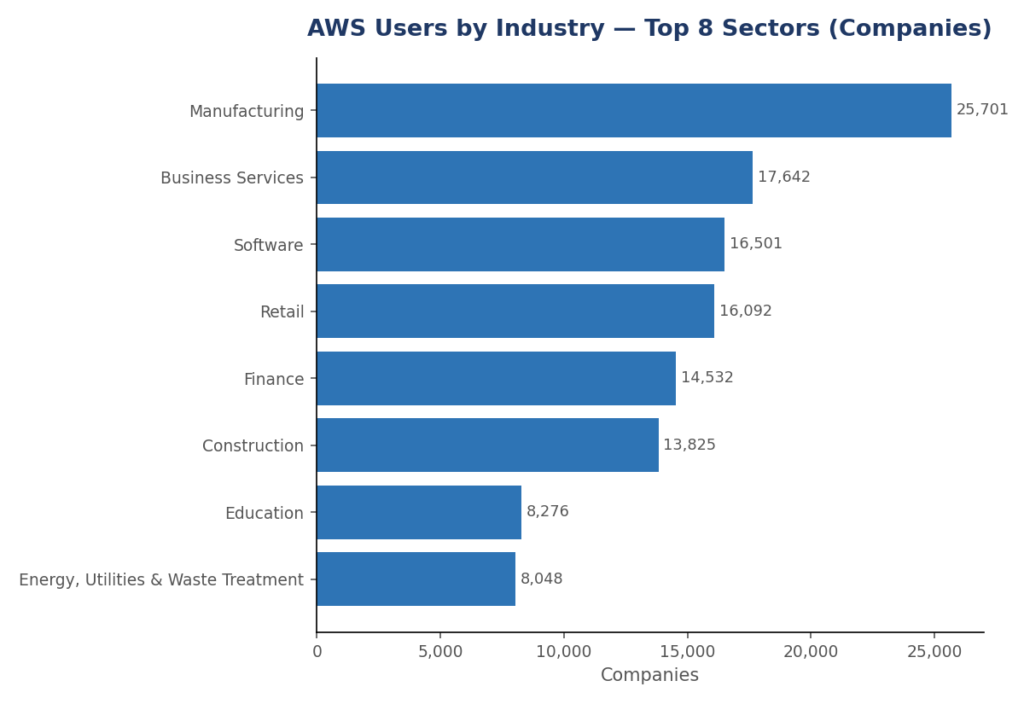
Manufacturing is the single largest industry in our AWS database (25,701 companies, 14.6% of the total), followed by Business Services (17,642, 10.0%) and Software (16,501, 9.4%). Together these three sectors account for over a third of every company in the database.
That’s a heavier manufacturing concentration than we see on Salesforce, where Business Services and Retail lead — likely reflecting how central AWS’s compute, storage and IoT services are to modern industrial operations. See the full breakdown, covering all 24 sectors, on our Companies that use AWS page.
AWS Users by Company Size
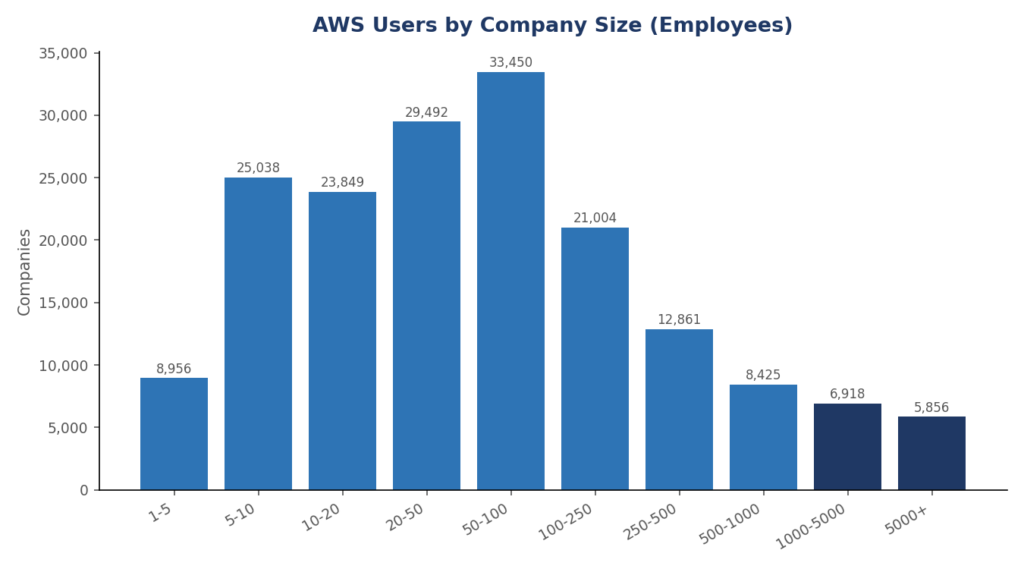
80.6% of the companies in our database (141,789) have fewer than 250 employees, while 19.4% (34,060) are larger enterprises with 250+ employees. That’s a notably higher SME concentration than we see on SAP (62.0%) — a reflection of how accessible and scalable AWS’s pay-as-you-go model is for smaller businesses, alongside its enterprise-grade capability for the largest organisations.
That range — from single-person startups to Fortune 100 enterprises — is part of what makes AWS users such a broad audience. A campaign aimed at a 10-person SaaS startup running EC2 looks nothing like one aimed at a JPMorgan Chase-scale enterprise, even though both count as “AWS users.”
Popular AWS Products Among UK Companies
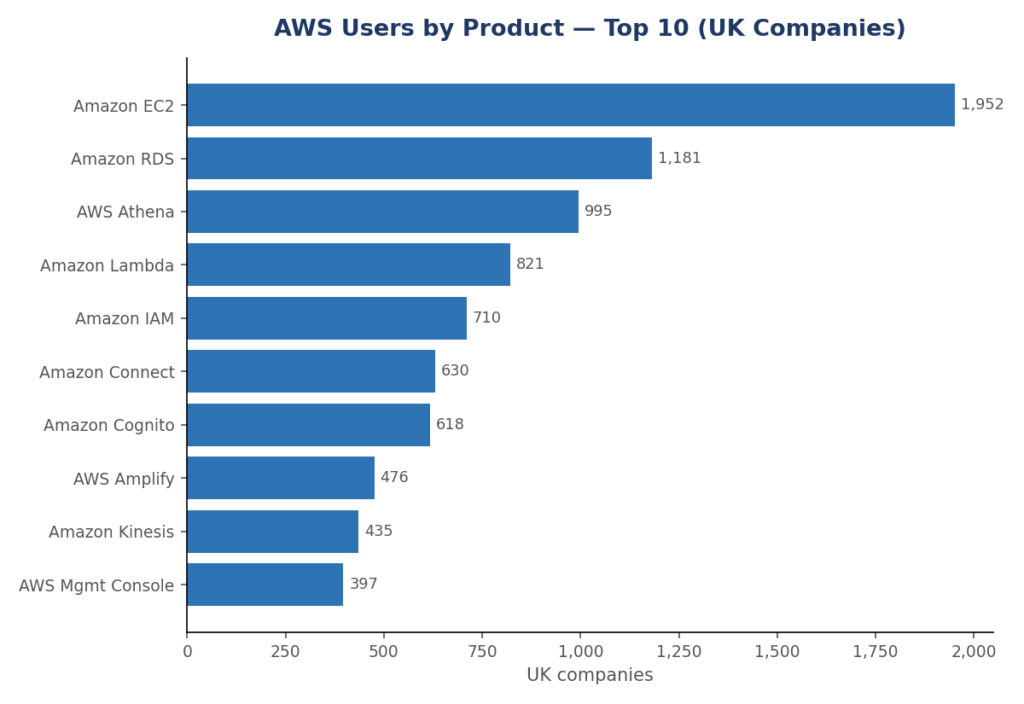
Our UK data can also be filtered by the specific AWS product or service a company runs. Amazon EC2 (1,952 UK companies) is the most common, followed by Amazon RDS (1,181) and AWS Athena (995) — core compute, database and analytics services that sit at the heart of most AWS deployments.
Because our data is filterable by product, a campaign aimed at EC2 users looks very different from one aimed at companies running AWS Amplify or Rekognition — matching your message to the right product matters more than targeting “AWS users” as one audience.

What This Means If You’re Targeting AWS Users
A few things follow from this data if you’re selling into the AWS ecosystem:
- Don’t assume enterprise-only. At 80.6% under 250 employees, the large majority of the addressable market is SME — AWS’s accessibility means it’s not just a Fortune 500 platform.
- The US is disproportionately dominant. At 68.5% of the global total, this is a more US-concentrated audience than Salesforce or HubSpot — worth factoring into campaign budget allocation.
- Manufacturing, Business Services and Software are worth leading with as sectors — together they account for over a third of all AWS companies in our data.
- Segment by product where you can. Our data is filterable by AWS product (EC2, S3, Lambda and dozens more), so a precisely targeted campaign beats a generic “AWS users” one.
How to Reach Companies Using AWS
If you’re selling into the AWS ecosystem — cloud consulting, DevOps tooling, AWS Marketplace products, migration services, or training — targeting companies that already use AWS is one of the most efficient ways to find warm, cloud-native buyers. Our Companies that use AWS list lets you filter by country, industry, company size and AWS product, so you can build a list that matches your ideal customer profile rather than buying generic B2B data.
Get the Data
Ready to reach AWS users directly? Request pricing for our Companies that use AWS list and get a free sample to check data quality before you buy.
AWS FAQs
How many companies use AWS?
Our Companies that use AWS list currently covers 175,849 companies and 791,756 decision-maker contacts worldwide, filterable by country, industry, company size and AWS product.
What are the biggest companies that use AWS?
Well-documented, publicly verifiable AWS users include Netflix, Capital One, JPMorgan Chase, Pfizer and Formula 1, alongside major names like Airbnb, Adobe, BMW, McDonald’s and Samsung. All of these are confirmed by official AWS case studies or AWS blog posts, not just recycled claims.
Which industries use AWS the most?
Manufacturing is the largest industry in our AWS database (25,701 companies), followed by Business Services (17,642), Software (16,501), Retail (16,092) and Finance (14,532) — though AWS is used across almost every major sector.
Is AWS mostly used by large enterprises, or small businesses too?
Predominantly small and mid-sized businesses. In our data, 80.6% of AWS companies have fewer than 250 employees, while 19.4% have 250 or more — a notably higher SME share than platforms like SAP, reflecting how accessible AWS’s pay-as-you-go pricing model is for smaller companies.
Can I get a list of companies using a specific AWS product, like EC2 or S3?
Yes. Our data is filterable by AWS product and service, alongside country, industry, company size and job role — get in touch with your specific requirements and we’ll confirm exact counts.