Which Companies Use HubSpot? A 2026 Breakdown by Industry and Company Size
HubSpot has grown from a marketing-blog tool into one of the most widely used CRM platforms in the world, and the scale is easy to state but harder to make specific. HubSpot itself reports 299,458 paying customers globally and $3.45 billion in annual recurring revenue as of Q1 2026, with revenue up 23% year-on-year, and it now holds an estimated 38% share of the global marketing automation software market, more than any other platform. But “HubSpot is popular” doesn’t tell a marketer, developer, or competing vendor much on its own. The more useful question is which companies actually use it, in which industries, and at what size, so we pulled the answer from our full List of Companies Using HubSpot, a database of 34,992 companies and 150,967 verified decision-maker contacts currently using the platform, and the patterns line up closely with how HubSpot itself describes its customer base.
How Many Companies Actually Use HubSpot, and Where?
Our database covers 34,992 companies and 150,967 contacts across HubSpot’s marketing, sales, and service platform, spanning 28 countries. The United States accounts for the largest share by some distance, 22,781 companies, or roughly 65% of the total, but the UK is clearly the second-largest market, with 4,928 companies and 18,227 contacts, around 14% of the global company count. That lines up with HubSpot’s own reported footprint: independent technographic tracking from 6sense puts the UK as HubSpot’s second-largest market too, with a similar gap behind the US, though its estimate of the UK’s exact share, around 10%, is lower than what our own data shows, most likely a difference in methodology, technographic detection of installed tools versus verified decision-maker contact records, rather than either figure being wrong. Either way, both sources agree on the same shape: the US leads by a wide margin, and the UK is a clear, distant second ahead of every other market. If you’re tracking adoption across more than just HubSpot, this data sits within our wider Software Users Email Lists collection, covering SAP, Salesforce, Microsoft Dynamics and other major platforms too.What’s Actually Included Under “HubSpot”
HubSpot isn’t a single product any more than Microsoft Dynamics or Salesforce are. It’s built around five connected “Hubs”:- Marketing Hub — its original product, covering email, landing pages, SEO and campaign automation.
- Sales Hub — CRM, pipeline management and sales automation.
- Service Hub — customer support and ticketing.
- CMS Hub — HubSpot’s own website content management system.
- Operations Hub — data syncing and process automation between the others.
Which Industries Use HubSpot Most?
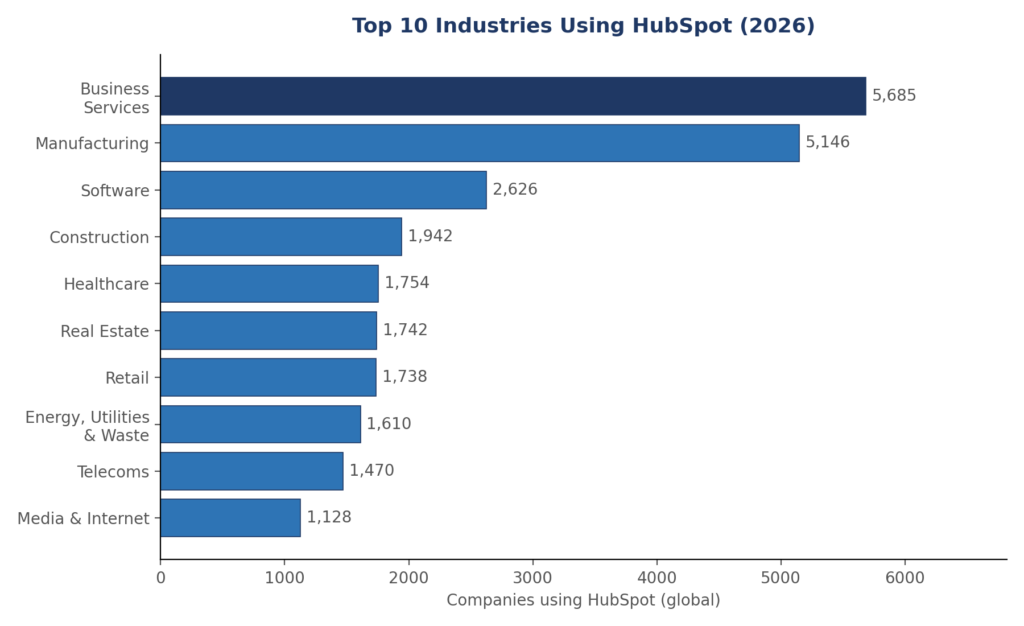
The top industries using HubSpot, by number of companies, are:- Business Services — 5,685 companies (16.2%).
- Manufacturing — 5,146 companies (14.7%).
- Software — 2,626 companies (7.5%).
- Construction — 1,942 companies (5.6%).
- Healthcare — 1,754 companies (5.0%).
- Real Estate — 1,742 companies (5.0%).
- Retail — 1,738 companies (5.0%).
Company Size: The SME Story Behind HubSpot’s Growth
This is where HubSpot’s own numbers and ours tell the clearest, most consistent story. HubSpot has publicly stated it holds 62% of all SMB CRM installations, and our database backs that up emphatically: 82% of the companies in our HubSpot dataset have fewer than 250 employees, a noticeably higher SME concentration than we’ve found on other major platforms we track. For comparison, roughly two-thirds of companies in our Microsoft Dynamics database fall under 250 employees, and around 80% in our Stripe database, both platforms with real SME reach, but neither matches HubSpot’s degree of concentration at the smaller end. The single largest size band on its own is 20-50 employees, 5,527 companies, closely followed by 5-10 employees at 5,779. Companies over 1,000 employees make up less than 7% of the total. If there’s one figure that captures what HubSpot actually is in practice, rather than in its own marketing copy, it’s this: an overwhelmingly small-and-mid-market platform, not an enterprise one, however far upmarket its more recent product tiers have tried to push.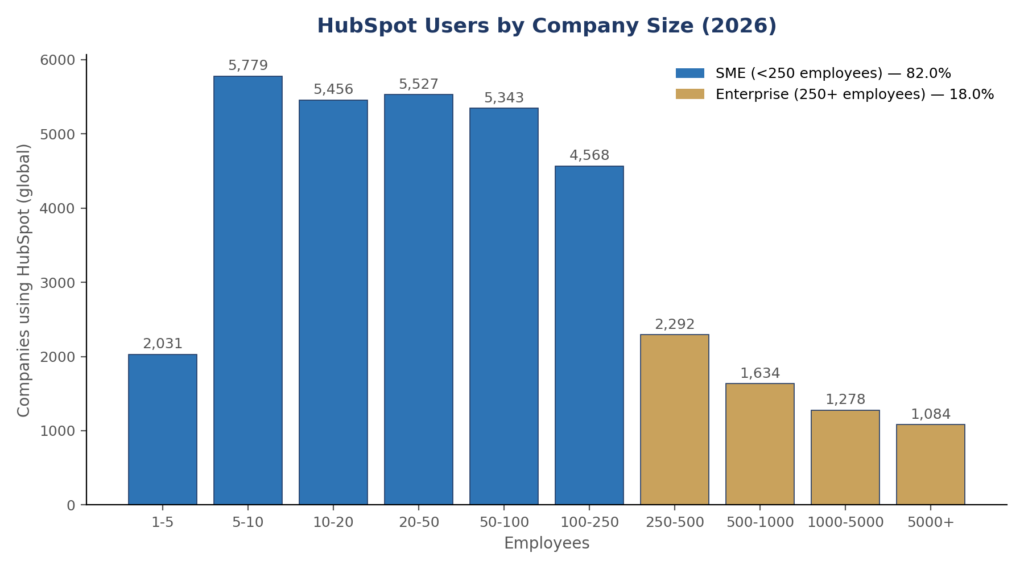
What This Means If You’re Targeting HubSpot Users
For competing CRM and marketing-automation vendors, HubSpot app and integration developers, or agencies offering HubSpot implementation and management services, a few things follow from this data:- An SME-first strategy will reach the overwhelming majority of the market — with 82% of HubSpot users under 250 employees, campaigns and pricing built around enterprise procurement cycles will miss most of the addressable base.
- Business Services and Manufacturing are worth leading with as sectors, not afterthoughts — together they account for close to a third of all HubSpot companies in our data.
- The UK is a genuinely sizeable market in its own right, not a rounding error behind the US — at roughly 14% of the global company count and a clear second place ahead of every other country, it justifies UK-specific messaging rather than reused US copy.
- If you’re building competitive positioning against HubSpot specifically, its own strength — SME concentration and marketing-services adoption — is also where the highest density of prospects sits, so a head-on competitive campaign will find its targets in the same places HubSpot already dominates, not around the edges of its business.