
Salesforce is the world’s most widely used CRM platform, and its customer base ranges from single-person startups to some of the largest companies on the planet. If you’re trying to work out whether Fortune 500 companies actually use Salesforce — and how to reach the wider population of businesses running it — this article covers both: real, sourced examples of large enterprises using the platform, and a breakdown of our own Salesforce CRM Users List, which currently covers 54,194 companies and 295,448 decision-maker contacts worldwide.
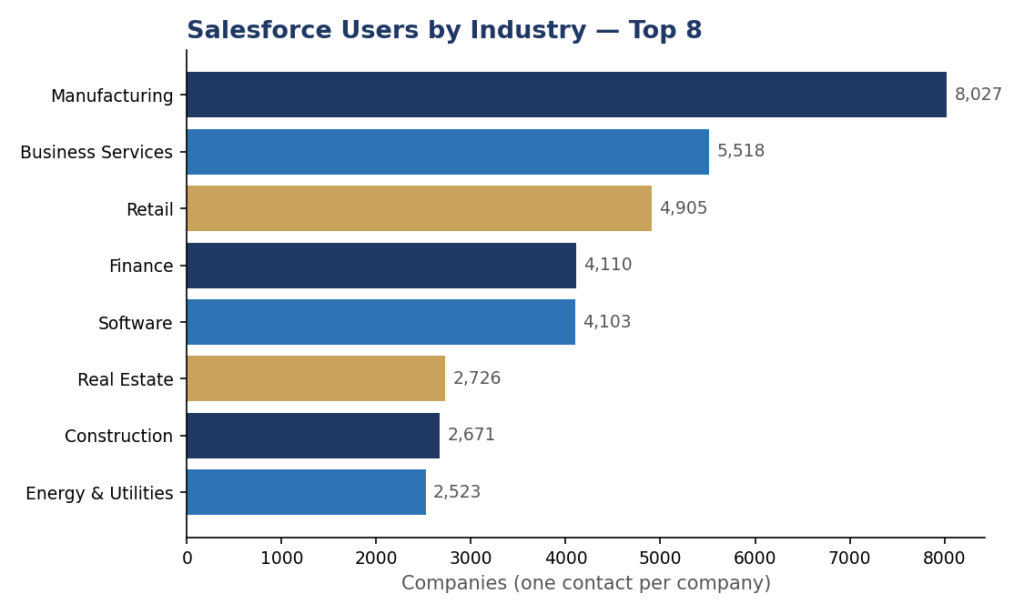 Manufacturing is the single largest industry in our database (8,027 companies, 14.8% of the total), followed by Business Services (5,518, 10.2%) and Retail (4,905, 9.1%). Together these three sectors account for over a third of every company in the database.
That’s a somewhat different pattern from HubSpot’s customer base, where Software and Construction follow more closely behind Business Services and Manufacturing — Salesforce’s spread looks more evenly distributed across traditional, higher-revenue industries. See the full breakdown, covering all 23 sectors, on our Salesforce CRM Users List page.
Manufacturing is the single largest industry in our database (8,027 companies, 14.8% of the total), followed by Business Services (5,518, 10.2%) and Retail (4,905, 9.1%). Together these three sectors account for over a third of every company in the database.
That’s a somewhat different pattern from HubSpot’s customer base, where Software and Construction follow more closely behind Business Services and Manufacturing — Salesforce’s spread looks more evenly distributed across traditional, higher-revenue industries. See the full breakdown, covering all 23 sectors, on our Salesforce CRM Users List page.
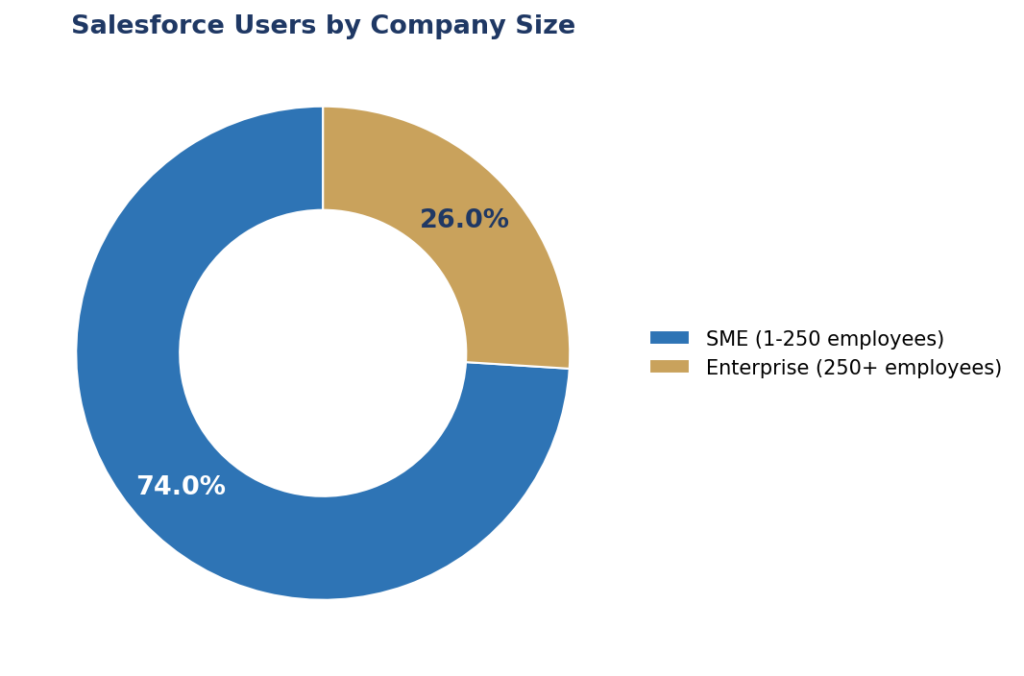 74.0% of the companies in our database (40,082) have fewer than 250 employees, while 26.0% (14,112) are larger enterprises with 250+ employees. That’s a lower SME concentration than we’ve found on HubSpot (82% SME) or Stripe (around 80%), which fits Salesforce’s positioning and pricing sitting further upmarket than either.
It’s still a majority-SME base overall, though, so a strategy built purely around large enterprise accounts would miss around three-quarters of the addressable market. A Salesforce rollout at a 20-person company looks very different from one at a 5,000-employee enterprise, and messaging that works for one rarely works for both.
74.0% of the companies in our database (40,082) have fewer than 250 employees, while 26.0% (14,112) are larger enterprises with 250+ employees. That’s a lower SME concentration than we’ve found on HubSpot (82% SME) or Stripe (around 80%), which fits Salesforce’s positioning and pricing sitting further upmarket than either.
It’s still a majority-SME base overall, though, so a strategy built purely around large enterprise accounts would miss around three-quarters of the addressable market. A Salesforce rollout at a 20-person company looks very different from one at a 5,000-employee enterprise, and messaging that works for one rarely works for both.
How Many Companies Use Salesforce, and Where?
Salesforce reports that its platform is used by over 150,000 companies worldwide, from small businesses to household names. Our own database — built and verified independently — currently covers 54,194 companies and 295,448 individual contacts, spanning 29 countries.- USA: 25,994 companies (48.0% of the total) — the largest market by some distance.
- UK: 8,940 companies (16.5%), 37,911 contacts — a clear second.
- Canada: 3,561 companies (6.6%) — a distant third.
What’s Actually Included Under “Salesforce”
Salesforce isn’t one product, it’s a platform of connected clouds, and which ones a company runs shapes how useful they are as a sales target:- Sales Cloud: the original CRM — pipeline and opportunity management.
- Service Cloud: customer support and case management.
- Marketing Cloud: email, journeys and campaign automation.
- Commerce Cloud: e-commerce.
- MuleSoft (acquired 2018): connects Salesforce to a company’s other systems via APIs — a signal of a more technically mature, integration-heavy customer.Tableau (acquired 2019): analytics and dashboarding.
- Slack (acquired 2021): Salesforce’s collaboration layer, sitting alongside the core CRM.
Do Fortune 500 Companies Use Salesforce?
Yes — and not in a small way. Three well-documented, publicly verifiable examples:- Toyota Motor Corporation: built Toyota Friend, a private social platform connecting drivers, dealerships and the company itself, on Salesforce Chatter. “People have only 24 hours a day,” says Toyota President and CEO Akio Toyoda. “But through social we can connect with many people at once.”
- FedEx: an $89 billion global logistics company delivering 17 million packages daily to 220 countries, has run on Salesforce for over 16 years. Using Data 360 to unify sales, shipping and web data in real time, FedEx reported over 2,000% ROI and a jump in customer activation from 25% to 40% in five months.
- Moody’s Analytics: uses Agentforce and Data 360 to help service reps resolve cases faster and turn support interactions into revenue opportunities, part of a wider shift among large financial-services firms toward AI-assisted, data-unified customer service.
Manufacturing is the single largest industry in our database (8,027 companies, 14.8% of the total), followed by Business Services (5,518, 10.2%) and Retail (4,905, 9.1%). Together these three sectors account for over a third of every company in the database.
That’s a somewhat different pattern from HubSpot’s customer base, where Software and Construction follow more closely behind Business Services and Manufacturing — Salesforce’s spread looks more evenly distributed across traditional, higher-revenue industries. See the full breakdown, covering all 23 sectors, on our Salesforce CRM Users List page.
Salesforce Users by Company Size
74.0% of the companies in our database (40,082) have fewer than 250 employees, while 26.0% (14,112) are larger enterprises with 250+ employees. That’s a lower SME concentration than we’ve found on HubSpot (82% SME) or Stripe (around 80%), which fits Salesforce’s positioning and pricing sitting further upmarket than either.
It’s still a majority-SME base overall, though, so a strategy built purely around large enterprise accounts would miss around three-quarters of the addressable market. A Salesforce rollout at a 20-person company looks very different from one at a 5,000-employee enterprise, and messaging that works for one rarely works for both.
Why Salesforce Dominates the Enterprise CRM Market
Salesforce is the world’s #1 CRM provider, holding a 20.0% global market share (IDC, Worldwide Semiannual Software Tracker, April 2026) — more than its next several competitors combined in most reports. That scale is part of why large organisations — including Fortune 500 names like Toyota, FedEx and Moody’s — standardise on it: a well-supported, established choice with a vast partner and integration ecosystem, backed by acquisitions (MuleSoft, Tableau, Slack) that extend it well beyond a standalone CRM into a genuine operating platform for sales, service, marketing, analytics and internal collaboration.What This Means If You’re Targeting Salesforce Users
For CRM integration vendors, implementation consultants, marketing-automation add-ons, and agencies offering Salesforce services, a few things follow from this data:- Product matters more than platform. “Salesforce users” isn’t one audience — a MuleSoft integration pitch and a Marketing Cloud add-on pitch need different messaging entirely, and our data lets you filter by product to target the right one.
- Don’t assume enterprise-only. At 74% SME, the bulk of the addressable market is still under 250 employees, even though Salesforce skews more upmarket than platforms like HubSpot.
- Manufacturing, Business Services and Retail are worth leading with as sectors — together they account for over a third of all Salesforce companies in our data.
- The UK is a real, standalone market — at 16.5% of the global company count and a clear second behind the US, it justifies UK-specific campaigns rather than reused US messaging.