Microsoft Dynamics in the UK: A 2026 Breakdown by Industry and Company Size
Microsoft Dynamics has become one of the default choices for UK businesses moving off spreadsheets and legacy systems, and the wider numbers back that up. The UK’s CRM software market alone is estimated at around £2.9 billion in 2025, growing at roughly 12.6% year-on-year among small and medium-sized enterprises, and 91% of UK companies with ten or more employees now run some form of CRM software. Globally, Microsoft’s Dynamics 365 business posted 23% revenue growth in its most recent quarter, putting it among the fastest-growing platforms in the CRM market. But “the UK uses Dynamics” doesn’t tell you much on its own. The more useful question is which UK businesses, in which industries, and at what size, so we pulled that answer directly from our own database of 6,895 UK companies and 29,650 verified decision-maker contacts currently running Microsoft Dynamics, and the patterns are worth a closer look.
How Big Is the UK Microsoft Dynamics Market, Really?
Our UK dataset, 6,895 companies and 29,650 contacts spanning Dynamics GP, Dynamics 365 Finance and Operations (formerly AX), Dynamics 365 Business Central (formerly NAV), and Dynamics 365 Customer Service (CRM), sits inside a global database of 35,855 companies and 154,276 contacts. That puts the UK at roughly 19% of the companies in our global Dynamics footprint, second only to the United States, which accounts for around 62% of the global total on its own. Third-party technographic estimates put the UK’s share of Microsoft Dynamics customers somewhat lower, in the 12-15% range depending on the specific product line, according to market-share tracking from 6sense covering CRM and Business Central separately. The gap is most likely down to methodology, technographic website and tech-stack detection versus verified decision-maker contact records, rather than either figure being wrong. Either way, every credible source agrees on the same shape: the UK is one of the two or three largest Microsoft Dynamics markets in the world, and one growing quickly enough that this kind of data is worth refreshing regularly rather than relying on a single snapshot.
What’s Actually Included Under “Microsoft Dynamics”
One reason UK Dynamics data is harder to pin down than it looks is that “Microsoft Dynamics” isn’t one product, it’s a family of four, and each pulls a different type of buyer. Dynamics GP is the older, mostly on-premise finance and accounting system, still common among established mid-market companies that haven’t migrated to the cloud. Dynamics 365 Finance and Operations, the rebrand of Dynamics AX, is the enterprise-grade ERP aimed at larger, often multi-entity organisations with complex finance and supply-chain needs. Dynamics 365 Business Central, formerly Dynamics NAV, is Microsoft’s cloud ERP built specifically for small and mid-sized businesses, and is the product most responsible for pulling smaller companies into the Dynamics ecosystem. Dynamics 365 Customer Service, Microsoft’s CRM product, sits apart from the finance/ERP side entirely and is used by sales and service teams regardless of company size. Our dataset spans all four, which is part of why the company-size split below looks the way it does: Business Central pulling in smaller businesses sits alongside Finance and Operations serving larger ones, in the same overall figures.
Which UK Industries Use Microsoft Dynamics Most?
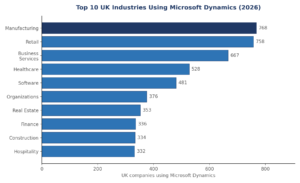
Manufacturing (768 companies), Retail (758) and Business Services (667) are the three largest sectors in our UK Dynamics dataset, followed by Healthcare (528) and Software (481). Together, these five sectors account for over 45% of all UK companies in the list. What’s more interesting than the ranking itself is how closely it mirrors the global picture. When we compared the UK’s industry mix to the global one company-by-company, the two turned out to be almost identical, with the largest gap anywhere in the list under one percentage point. The one sector where the UK genuinely under-indexes is Energy, Utilities & Waste Treatment, which makes up 4.2% of the UK list against 4.7% globally, a modest but consistent gap. In practice, this means there’s no major UK-specific industry skew to plan around: Microsoft Dynamics adoption here tracks the same sectors driving adoption everywhere else, led by manufacturing, retail, and professional and business services, rather than following some distinctly British pattern.
Company Size: Who’s Actually Buying Dynamics in the UK?
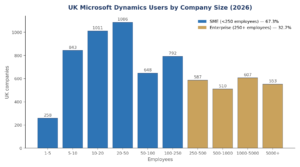
Employee-size data tells a similarly consistent story, with one small twist. Just over two-thirds of UK companies in our Dynamics dataset, 67.3%, have fewer than 250 employees, near enough identical to the 67.5% SME share in the global dataset, confirming Dynamics isn’t only an enterprise play in the UK any more than it is anywhere else. The one place the UK data ticks up is at the very bottom of the size scale: businesses with 1-5 employees make up 3.7% of the UK list, compared with 3.1% globally, a small but real tilt toward the smallest end of the market. That lines up with the wider UK trend of CRM adoption spreading into smaller businesses. SME CRM adoption is growing at around 12.6% a year, faster than the market as a whole, and it’s consistent with Microsoft’s own positioning of Dynamics 365 Business Central as an accessible entry point for growing SMEs rather than purely a large-enterprise ERP system. It’s a reasonable bet that this micro-business segment is disproportionately Business Central rather than Finance and Operations, though our current data doesn’t split company size by specific Dynamics product, so treat that as an informed inference rather than a confirmed figure.
What This Means If You’re Targeting the UK Dynamics Market
For implementation partners, competing software vendors, or B2B sales and marketing teams building outreach lists, a few things fall out of this data. First, the market is broad rather than narrow. With adoption spread fairly evenly across sectors, a UK Dynamics targeting strategy built around any single industry will miss the majority of the market rather than capture a real niche within it. Second, most of the opportunity sits with SMEs, not enterprise accounts. Two in three UK Dynamics users have fewer than 250 employees, so messaging and pricing built around enterprise procurement cycles will be a poor fit for most of the addressable market. Third, the UK isn’t a small satellite of the US market. At roughly a fifth of the global company count, it’s a market large enough, and different enough in its own right, to warrant UK-specific targeting rather than reused US messaging. Fourth, because the product family spans everything from legacy on-premise finance software to modern cloud CRM, “Microsoft Dynamics users” is not a single audience with one message, it’s at minimum two: finance and operations buyers on one side, sales and service buyers on the other, and worth treating separately in outreach.
Get the Full Dataset
The figures above are a snapshot of what’s in our full Microsoft Dynamics Users List: 154,276 contacts across 35,855 companies globally, including the UK breakdown above, fully filterable by industry, country, employee size, job title and seniority. If you need a list built to specific criteria, UK manufacturing companies under 50 employees, for example, that’s exactly the kind of targeting this data supports. Microsoft Dynamics is one of several platforms covered in our wider Software Users Email Lists collection, alongside SAP, Salesforce, HubSpot, NetSuite and other major systems, if Dynamics isn’t the only platform you’re targeting.